

Homebrew Extra Retro Gamer 279
The homebrew scene certainly shows no signs of slowing down. Our main feature looks at a new way of creating Game Boy titles, the Champion Coder is attempting an ambitious Atari conversion, and we look at an Amstrad CPC remake. With plenty of news and the usual reviews, it’s another packed column. And next time we’ll be looking forward to the great games you will be playing in 2026…

QUICK LINKS
BACK TO BASICS
Tony Wang has created GameBuilder Basic, available via https://bit.ly/gb-basic, designed for wannabe Game Boy programmers to make their own games.
Interview with Tony Wang on GameBuilder BASIC:
What got you interested in Game Boy programming?
Tony: For me, the Game Boy isn’t just a gaming device; it’s an icon of an era, a symbol where gaming dreams began. My journey with games started in the 8-bit era, progressing through 16-bit, early 32-bit polygonal graphics, and eventually into the modern console generations. Similarly, my programming experience began with LOGO and BASIC on 8-bit computers, followed by QBASIC, Visual Basic 6, and eventually industry-standard languages like C/C++ and C# that I’ve used professionally since graduating in 2009. I’ve also dabbled in app and web development, as well as crafting compilers and interpreters for fun.
Reflecting on the evolution of the gaming industry and computer technology, I believe the two decades from the early 1990s to the 2010s were a period of rapid advancement in user experience, developer tools, and how players interacted with games. While hardware, visuals, design philosophies, and development practices have continued to evolve since 2010, I feel that recent progress lacks some of the excitement and future-looking impact that characterised the leaps from 8-bit to 16-bit, then to polygonal and next-generation graphics. The 2010s almost feel like a dividing line.
Recently, I’ve noticed a fascinating trend: many players, including myself, have reignited their nostalgia for older consoles and games. Even younger players are showing interest in titles released before their time. The technical limitations of 8-bit devices forced developers to focus more on gameplay - an aspect I believe has seen the most meaningful progress since the 2010s and is far more thought-provoking than graphical advancements. Moreover, players tend to be more forgiving of technical constraints in 8-bit games. Combined with today’s culture of creation and sharing, the lower technical barrier and emphasis on gameplay make development more accessible, aligning perfectly with the “anyone can create something” ethos of our time.
Handheld consoles have always held a special place in gaming. In an era dominated by smartphones, traditional handhelds like the Game Boy feel even more precious: they’re dedicated devices free from the distractions and social anxieties of likes and comments. They offer a personal space for immersion and even unique ways of sharing joy, like face-to-face multiplayer sessions.
The Game Boy was my first handheld, and as a player, I have deep nostalgic ties to it. As a developer, it’s my favourite platform to work with. Ultimately, my motivation stems from fond memories of childhood gaming and the friends I shared those moments with. I believe many others are drawn to Game Boy gaming and programming for similar reasons. This sentiment inspired me to develop GameBuilder BASIC (GB BASIC), hoping it would help others discover the joy of creating and playing Game Boy games.
Why did you devise a new “fantasy console” with a BASIC-style language?
BASIC is simple to learn and empowered many bedroom programmers to write code, often setting them on the path to becoming professional developers. It’s also a language I used for a long time. From a technical perspective, GB BASIC uses a virtual machine to execute Game Boy game functions. This VM interprets a custom assembly instruction set, and old-school BASIC maps quite neatly to this structure. In short, pairing a technically constrained platform with BASIC strikes a balance between development cost, efficiency, runtime performance, and final game presentation. And it is fun to code in BASIC!
It’s termed a “fantasy console” because, in addition to running on GB/GBC compatible hardware, it extends functionality beyond the original hardware, such as support for mice, touchscreens, keyboards, and other mechanisms that allow game ROMs to “communicate” with the outside world.
How long has it taken to develop, and what did you use to develop it?
From the day I wrote the first line of code (September 13, 2022) to the first public release (August 20, 2025), it took nearly three years.
I primarily used C/C++ for their low-level efficiency. The application itself is built on common graphics and UI libraries like SDL and ImGui. To maintain full control over the compilation process and ensure fast compile times, the compiler was handcrafted from scratch in C++. The runtime component is based on an open source virtual machine (the GBVM project), written mostly in C with some Game Boy CPU assembly.
The process was quite challenging. One of the biggest hurdles was ensuring the BASIC VM ran smoothly under the Game Boy’s strict performance limits while retaining expandability for advanced and “fantasy” features. The graphical editor required implementing import, export, editing, and asset pipeline functionalities to correctly package resources into ROMs. Interestingly, the compiler was the first module to become usable, during the early prototyping phase, it could already compile simple Hello World programs and basic syntax without a GUI.
Note: You can find other key milestones at https://paladin-t.github.io/kits/gbb/changelog.html
What are the benefits of using GB BASIC over other methods of Game Boy development?
1. It’s more friendly to those who prefer coding, though this depends on individual preferences. If you’re looking for a code-based development environment, GB BASIC is a great choice.
2. Fast compilation, on my machine, a project with multiple levels and full game logic typically compiles and launches in 0.05 to 0.15 seconds. This is crucial for prototyping and rapid iteration.
3. Most tools needed for Game Boy development are built-in. My goal is to let developers focus on creating games within one software, only resorting to external tools when absolutely necessary. This helps keep the focus on the game itself rather than tedious steps like format converting, compiling, debugging, and packaging.
In short, GB BASIC aims to bridge the gap between graphical tools and hardcore C/assembly programming, offering a comfortable space for creators who enjoy coding but want to see results quickly.
What are some of the unique features of GB BASIC?
Compared to traditional BASIC, it offers a unique thread concept that simplifies writing concurrent behaviours.
Compared to other Game Boy-specific tools, its “fantasy” features extend compatibility to web and desktop platforms while enhancing the player experience with support for touchscreens, mice, keyboards, and more, all while remaining compatible with Game Boy models.
Are people free to make commercial ROMs or physical carts from a GB BASIC title?
Yes, GB BASIC can produce fully compatible GB/GBC games. Developers retain full copyright over their works and resulting ROMs. GB BASIC does not impose additional terms or charges. Developers are free to distribute their ROMs in any form they choose.
Note: More licensing information is available at https://paladin-t.github.io/kits/gbb/about.html
How did you develop the example games, and are you planning any more?
In addition to documentation, I’ve included a set of examples and several starter kits. The examples demonstrate specific features and were often written during the implementation of those features to validate parts of the workflow. The starter kits are more complete game projects, serving as templates for developers. They include sample assets, essential game flow, and logic code. I created these kits after finalising all planned features.
As new APIs and syntax improvements are added, I plan to include more examples for reference. I also aim to expand the starter kits to cover more genres and project scales.
What features are you planning to add in the future?
In the next update, I plan to support custom kernels, enabling advanced users to compile their own GB BASIC kernels with GBDK-2020 for extended functionality. Regular users will also be able to install these kernels. Editor improvements will include more intuitive tools, like pixel-level drawing on maps instead of tile-based editing. A user-friendly debugger is also in the works to simplify troubleshooting. For the built-in emulator and exported runtime, I intend to add SGB support and an on-screen keyboard. Kernel-side optimisations and new fun features will also be considered.
Another high priority is developing web-based interactive tutorials, allowing beginners to try out what they learn directly in a browser. While this will be web-deployed, I consider it an integral part of the software and a valuable addition to existing learning materials like documentation, examples, and starter kits.
Have you seen any games developed with GB BASIC yet by other people?
Yes, I’m aware of several projects in development. One developer is working on two games: a tank-themed platformer and an early-stage barbarian-themed game.
Have you used any other Game Boy dev tools, and are there any you recommend?
I’ve tried GB Studio, which is incredibly user-friendly, packed with advanced features, and supported by a vibrant community. In fact, GB BASIC drew some inspiration from it. I highly recommend it for those who prefer visual development.
Personally, I prefer coding, so for similar users, I recommend GBDK-2020, a C compiler environment that also supports inline assembly. It’s geared toward advanced users because working with C often means implementing higher-level abstractions or relying on external tools, which have a steeper learning curve. Worth noting: GB BASIC’s runtime is compiled with GBDK-2020. With the upcoming custom kernel feature, users will be able to compile their own GB BASIC kernels using GBDK-2020 for even more functionality.
What recent Game Boy homebrew titles have impressed you?
I’ve been consistently impressed by the quality of recent Game Boy homebrew releases. Self Simulated ( https://2ndlawgames.itch.io/selfsimulated ) stands out with its clean visuals and brilliantly designed, progressively challenging puzzles. It perfectly demonstrates how delicate games can be created on limited hardware. Another title, Melon Journey Pocket ( https://poppyworks.itch.io/mjp ), is a charming RPG that amazed me by evolving from a homebrew Game Boy game into a full-fledged multi-platform release, Melon Journey: Bittersweet Memories, for PC and consoles. There’s even a physical release for Nintendo Switch that is bundled with a Game Boy cartridge ( https://beep-company.com/melon-journey/ ).
Mini Barbarians and Jumping Tank are currently in development with GB BASIC.
SPEAKING YOUR LANGUAGE
Five other ways to make your own Game Boy Game
GBStudio
With a great community at https://www.gbstudio.dev/, the drag & drop environment made developing games like Taskmaster (RG249) easier.
GBDK 2020
Following Larold’s tutorials at https://bit.ly/gbdk-tutorials will help you understand this C-based development kit, used for the recent Luigi’s Mansion demake.
ZGB
Platform game Powa (RG234) was created in this environment based on GBDK 2020, which allows C or assembly code. https://bit.ly/zgb-github
RGBDS
The Rednex Game Boy Development System is for assembly programmers; read Bitnefer’s tutorial on building Flappy Boy. https://bit.ly/flappyboy-tutorial
WLA DX
For advanced assembly, this multi-platform tool was used for Void Stranger (a Soko-Ban-inspired puzzler) in GB Compo 2025. https://bit.ly/wladx-github
NEWS BYTES
Amiga: The Scorpion Engine wiki for developers is now available at https://bit.ly/scorpion-wiki
Atari/Intellivision: AtariAge added 15 new titles to their web shop, including Akalabeth for Intellivision. https://bit.ly/new_atariage
C64: Bubble Bobble Remastered features improved graphics and a new title tune. https://bit.ly/bbr-c64
Enterprise 128: The latest games from KTB Retro Computing (see RG278, also on ZX Spectrum) are Maisie Day Is Not OK, and Little John Can’t Jump. https://bit.ly/ktb-enterprise
Game Boy Color: Infinity is a massive RPG, originally developed from 1999-2001 by Affinix Software, and now available to pre-order from Incube8. https://infinitygbc.com
MSX: MSXdev 2025 is underway, with the deadline of 15th March 2026 and more than 10 entries already confirmed. https://www.msxdev.org/msxdev25/
Plus/4: The brilliant Death Sector by Csabo mixes Cybernoid-style movement with puzzles to solve. https://bit.ly/deathsector
Vectrex: Major Tom by Scott Huggins and Gyrostonomy/Gyrostology by Peer Johannsen (with a unique rotatable overlay) are available from https://www.vectrexmulti.com/
ZX Spectrum: RetroSouls released their latest, Zak McDrucken Saves The Chickens. https://bit.ly/chickens-zx
The Midnight Brew 2025 Collection (including Gorf, Frogger RX, Space Invaders, Lock ‘n Chase, and Wycheweald/Hafoc Tor) is available at: https://bit.ly/brew2025-zx.
Various: Volcano Bytes released Trasmoz Legends (follow-up to Curse of Trasmoz and Revenge of Trasmoz) for Steam, Xbox Series, Switch, and PS4/5.
Platypus Reclayed, a shoot ‘em up featuring clay models and C64 remixes, launched for modern platforms. https://claymatic.games/platypus-reclayed

CHAMPION CODER - VEGA (ATARI 8-BIT)
[Info]
From: City and country: GDYNIA, POLAND
Website: https://vega.atari.pl
Format: Atari XE/XL
Previous games: Bubble Bobble, Mikie, Cyborg Warriors, Bomb Jack
Working on: Street Fighter II (XE/XL)
Taking his pseudonym from Capcom’s fighter, Vega’s Street Fighter II conversion is progressing rapidly.
What prompted you to port Street Fighter II?
One time, I saw the Game Boy version of SF2 by accident. I was sure that it's the same version is possible on the ATARI XE/XL. And it might even be better because we can add more colours... not only 4 colours like on GB.
So I started writing the drawing routines, and it turns out that drawing is not as slow as I thought. Then even the 4KHz samples were added, the game didn't slow down. It was surprising and encouraging to continue.
What programming tools do you use, and do you test on real hardware?
The basic assembly programming tool is MADS (author: TEBE), and the graphics program is Graph2Font (author: TEBE).
Regarding the music, we use the Raster Music Tracker (author: Raster/C.P.U).
In addition, we also use a PC graphics program, for example, GIMP.
We have a very good emulator, ALTIRRA, which emulates the real ATARI very well, and the game is tested on it.
Tests on real hardware are also, of course, but only at the end, at the advanced level of the game.
How difficult was it to create the graphics with such a large number of animation frames and detailed backgrounds?
The sprites were already finished, so we only had to convert them, sometimes maybe a few changes. The backgrounds were also finished, but they were rather weak, so they were improved (more colors and details were added).
How is the music and sound created?
The music was created by MIKER in RMT. I don't know how he makes it, but many times I write to him that I need music, and the same day music is ready :)
In this game, I use for the first time the 4KHz samples instead of the sound effects created in RMT.
Due to these samples, we have sounds similar to the AMIGA/ATARI ST version of the game, rather than the 8-bit version.
How many fighters are you planning to have in the game, and what special moves will be available?
Exactly the same as the Game Boy version, meaning we have 9 fighters.
Each of them has 2 or 3 special moves. Moreover, these special moves can take twice as much energy.
Are you worried that Capcom will prevent you from publishing?
I hope not; this is a hobby and not a commercial project.
Are you working on any other projects?
In this moment, no...SF2 is the only project at this moment.
Which homebrew Atari games have you enjoyed recently?
There have been some cool titles. The last one that I have seen and remembered was "Ruff in Trouble". The author of this game made excellent use of Atari's color capabilities, which is not easy.
When do you plan to release SFII, and will a physical version be available?
I believe the game will be completed by the end of September. About the physical version is a small problem. The game requires a 4MB MEGACART cartridge. Unfortunately, 4MB memory is used by this cartridge, that are no longer available. So a new 4MB cartridge, which uses 2x2MB of memory, is currently being developed. It takes some time yet.

DATABURST - REVIEWS
L’Abbaye des Morts
Format: Game Boy/Game Boy Color/Super Game Boy
Credits: Alekmaul Studio
Price: 39.99 Euros (physical edition preorder)
Locomalito’s original PC game was inspired by Spectrum graphics and has had multiple conversions over the years. Now the French Alekmaul team bring it to Nintendo’s handheld. The graphics have been recreated well, and Adan Toledo has done a great job with the soundtrack. The one drawback is that the smaller screen size means you occasionally take a “leap of faith,” unable to see enemies above or below you. This is a minor issue in an otherwise well-polished conversion, offering something different for Game Boy fans.
[Score] 83%
Note: The game is compatible with the original DMG Game Boy and Game Boy Color, and adds an extra border when played through Super Game Boy.
Bubbleback – The Story Of Forward To The Past 2
Format: ZX Spectrum
Credits: Sloanysoft
Price: Free
We’re big fans of Davey and Nate’s MPAGD games, especially Jet Set Steamboat Willie. The cute and colourful graphics are accompanied by a brilliant soundtrack from Lee Bee, including covers of the Back to the Future theme and Bubble Bobble. Another fantastic Sloanysoft release.
[Score] 86%
Mute Crimson DC
Format: Dreamcast
Credits: Iced Lizard Team
Price: Free
Based on the 2024 Steam DX release, an evil force is invading, and only a solitary ninja can stop it. In this precision platformer inspired by Super Meat Boy and Celeste, double-jump to avoid flames and lava while sword-slashing your way through enemies. The stylish graphics, well-drawn cutscenes, and the great chiptune soundtrack help sell this challenging but fun free title.
[Score] 87%
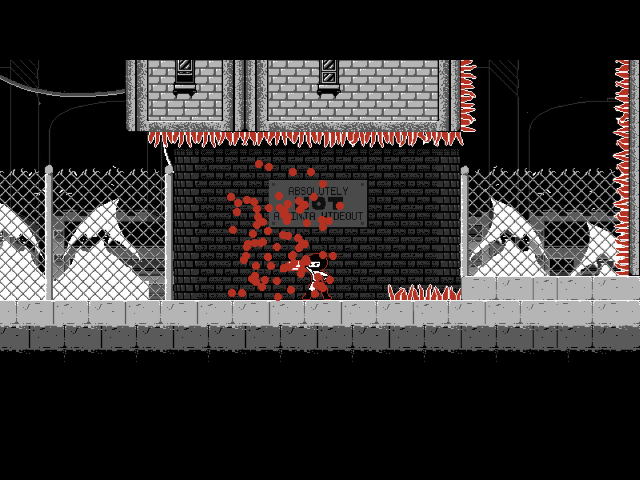
PROCESSING - TURRICAN128 (AMSTRAD CPC)
Ben Yoris (OneVision) talks about the remastered Turrican 128K for the Amstrad CPC.
What inspired you to remake Turrican for the Amstrad?
It was JMB who had the idea first. He likes to have a look at some oldies game code and see what can be accomplished to optimise or speed up critical routines. JMB had already worked on optim/remakes like Sly Spy or Shinobi. I joined the effort on Mario Bros last year, and this year I decided to help on this Turrican remake.
How were the new graphics produced?
First, JMB looks for exploitable graphics in the game code and resources. Then he sent me this material, and with Grafx2 I simply try to enhance or redraw some pixels to, hopefully, propose better graphics, or optimised ones.
What has been the most difficult thing about updating and changing the game?
You have to adapt to what has been done in the past. For example if a sprite has a given size, you can't go over it; you have to redraw sprites in the same matrix and palette. Sometimes it's frustrating because you'd want to do more. You also have to respect the number of frames for a given animation: whereas Turrican CPC has only a few frames for the running animation, with 128K, you could have more, but the original code doesn't allow it. So you have to deal with original constraints.
Are you planning to add anything else?
Concerning graphics, we updated the loading screen, main menu, Turrican himself (I wanted to have a sprite far closer to the Amiga) and the HUD. We were not able to add more things. I had started to redraw the walker enemy from early levels, but for some technical reasons, it was not possible to replace it in the end. JMB had a hard time including all additional music and making it fit on a disk image (even though Parados is needed). Memory is also paramount: 128K are easily and quickly filled!
How long has the project taken so far?
Believe it's JMB that worked on it longer than me! I think he spent multiple hours and evenings optimising the code. On my side, I'd say a few days in total to do the pixel art. Maybe he's planning another even more optimised version, who knows? ;)

Retro Gamer issue 279 was published on 20th November 2025
This blog was published on 8th April 2026


Comments