

Homebrew Extra Retro Gamer 282
For all the Mega Drive/Genesis creators out there, the Homebrew Factory ( homebrew-factory.com ) now allows you to configure and customise your cartridge and packaging – either as a pre-order campaign or for your own Kickstarter. And check out their new Game Boy Color physical release, Kero Kero Cowboy, at bit.ly/kerokero-gbc . Our main feature focuses on the BBC Micro, the Champion Coder has been working on Mega Drive games, and reviews include the recent Sonic GX. Enjoy!

QUICK LINKS
BBC BRILLIANCE
The BBC Micro celebrated its 44th birthday, with talented programmers continuing to push the hardware with new games. We talk to them about three recent projects.
Angus Hughes on Orion Patrol:
What is your development environment?
It's very simple and quite 'old-school'. For the actual programming, I have a MacBook Air on which I'm running the B2 emulator/debugger, the 'beebasm' assembler, and 'Sublime Text' as a file editor. There aren't as many tools to support development on the Mac as on PCs, so for the graphics I start with graph-paper, a pencil & some felt-tips, then move on to a customised Excel spreadsheet as my sprite-editor, where I can see everything on one tab, with cell shapes adjusted to mirror the BBC's various graphics modes. From there, I generate the actual bytes for each graphic.
Briefly, how did you create the 3D effect in Orion Patrol?
It would be far too time-consuming to plot a solid landscape as Zarch does, but this slimmed-down approach, born out of necessity (and influenced somewhat by Tron!), seems to work. The game uses a perspective projection, so the 160 (16 x 10) vertices of the landscape, as well as any particles (assorted bullets and engine flume), are calculated in a 16-bit 3D coordinate world. It was my first attempt at 3D, and to my pleasant surprise, after using a few tables to speed things up, there were far fewer multiplications needed than I expected. To achieve the foreground contours that give the impression of rolling hills, there's a simple approximation as to whether the adjacent vertex is higher, lower or the same height, and an appropriate gradient is plotted rather than a single pixel. It's an easy shortcut, but quite effective.
As far as the more detailed graphics, I modelled the main ship in Blender and converted it into 84 separate frames, whilst the other elements are all pre-defined sprites that have 6 possible sizes.
How are the level maps created and stored?
The levels are almost entirely calculated on the fly. Each level consists of 128 x 128 vertices, and the height of each is calculated by an algorithm that combines a number of different sine and cosine curves. The 'sea' is simply an arbitrary height, so we're effectively just seeing the upper section of the resultant curve. The original intention was also to change the landscape algorithm for different levels, but there just wasn't enough memory left.
The game then places 48 destructible features randomly wherever there's land. The vegetation is also calculated by its own algorithm, which avoids the sea and those 48 fixed features. After the initial plot at the start of a level, the game only ever needs to work out what's coming on screen at the edges by plugging the coordinates into the algorithms - everything else on-screen, including each vertex, is cached to make the game as fast as possible.
To add variety, the colours and feature sprites change between levels, so on level 2, the ground is a snowy white, and there are Christmas trees, and on subsequent levels, there might be burning fires or strange alien trees.
Are you working on any other projects?
I have a couple of ideas for what to try next; I've started thinking about a game based on a well-known IP that will feature large, highly animated and expressive cartoon characters; it's something a friend & I talked about many years ago and has always been at the back of my mind. Other than that, I'm keen to utilise the landscape engine from Orion Patrol; either possibly convert it to the Acorn Electron, or more likely, adapt and enhance it into a 3D Isometric fully-scrolling game as a follow-up to an unreleased game I wrote in 1988 called Dragon Quest. We'll see...

Chris Bradburne on Epsilon Protocol:
What development tools did you use?
I prototyped the renderer in BBC BASIC for SDL, then coded using VSCode and BeebASM. There is also a small Python script to combine the level files and a PowerShell script to build the game. Also used the Beeb-Em and b2 emulators to test and debug.
Can you explain briefly how you achieved the 3D effect?
With lots of lookup tables! The 3D effect is a ray casting engine - the same technique that Wolfenstein 3D used. For each of the 64 columns on the screen, a probe is sent into the room to determine which block is hit. This gives the colour and distance, and therefore the height of the column.
I compare the height and colour with the previous frame, which gives a list of columns to draw, allowing me to draw only the difference to the previous frame in most cases. The doors are textures that are fully redrawn each frame, which is why it slows down as you approach them.
This is also why the enemies are wireframes, as a large sprite could require redrawing most of the screen every frame, slowing the game down. The enemies also reuse the distance calculation to determine which parts of them are visible.
What was the most difficult part of creating the game?
Getting all the maths to work – at least to my brain. It’s not perfect – but it’s close enough. Then, trying to optimise the calculations and drawing for speed. However, the longest part was putting together the levels, but that was repetitive rather than hard.
How are the maps for each "room" created?
Each room starts as a solid block with a random number of thick lines removed from it. The positions of the doors and the enemy are also generated randomly. This means each room derives from a single 16-bit seed. In many cases, this doesn’t generate a usable room, so I created a program that drew all 65535 possible rooms and selected ones that were “interesting” to put together in a map for each level.
Each room is then stored as a seed number and a list of where the exits go to. There is also a status byte containing the enemy type and sometimes extra information for the special blocks (keys and health) that are hand-placed in the room. A whole level with 63 rooms takes a little over 400 bytes.
I actually had another algorithm originally (placing shapes into the room), but I didn’t like the results, so I had to throw away all the levels I had done and start again.

Stephen Williams (raspberrypioneer) on Boulderdash:
It was a fun way to enjoy the hobby over the usual collecting, fixing / future-proofing I’ve been doing, so I'm happy to share the experience. The GitHub repository includes all the tools needed to build the programs – mostly Python scripts.
Roughly, this is what I did:
• Bought an Electron and tried out the games, taking a particular liking to Boulder Dash and wondered if I could make some of the caves a bit easier (increasing time, reducing number of diamonds, etc.).
• Shared what I discovered on the Stardot forum and was pleasantly surprised that there was some interest, especially from Cybershark and Bill, to start with.
• Bill cracked how the caves were built in the program and enabled them to be loaded from files instead (game engine now separate from cave definitions). Slightly in the background, TobyLobster started a full disassembly. Both of these really unlocked what I added later on.
• Bill's work also paved the way for the cave editors, which he worked on to run in Windows (written in BBC Basic), and also Cybershark (runs on BBC/Electron). I was more of a tester at this stage, going onto creating fan-versions of the game using cave definition files from the Arno Boulder Dash website.
• We found where the sprites were defined, and Cybershark developed a sprite editor, which was used to give the game a different look!
• TobyLobster completed the disassembly of the original, which enabled me to add the loading mechanism which Bill created. I also added the pseudo-random mechanism for plotting elements (boulders, diamonds, etc) per the original Peter Liepa version. This meant that loaded caves could behave the same way as the original across the 5 skill levels, and new fan/other caves could be created too. I created a new GitHub repository for this version.
• The editors that Cybershark created were enhanced and tested.
• Someone on the forum asked about Boulder Dash 2 along the way, which has a couple of new elements. I added those to the game engine, created new caves, and tested it. Boulder Dash 3 was created, too, which just needed different caves (no new elements). I added a couple of my own features to a new version for bombs and zero gravity. Basically, these all run from the same game engine, with the different cave files allowing for BD1,2,3,+1 and fan versions.
• Cybershark mentioned that the game (original and enhanced), could be a bit temperamental controls-wise on the BBC micro, which TobyLobster helped me fix in the enhanced version.
• Cybershark went on to put all the games in a compendium DSD file. Separately, I merged cave files so that all games could be played from a single SSD file, which is better for my Electron.
It was a group effort in all this, and I’m grateful to the BD team for making this an enjoyable retro experience. You can probably tell, I had got a bit addicted to this! I went on to port the enhanced version onto the Oric and Vic-20.
We've missed out TobyLobster a bit. His contribution was huge - he disassembled the original game and fixed an annoying keyboard control problem (more evident on the BBC micro / BeebEm). He did an amazing job.
My [development] environment is Windows, using VSCode to develop on, compiling with the Acme 6502 assembler. The Beeb emulator is used to test programs with. I also use Beeb Image and MMB Explorer from time to time to check/change files in the SSD. I create the SSDs using Python, which means the build-to-run set-up is quick and easy (this is all in the GitHub repo). Regarding real kit, I don’t have a BBC, although I wanted one as a lad (I’m pretty new to the BBC micro world, having been a Commodore person bitd). Instead, I use an Electron for final testing. I bought it a couple of years ago, along with a cool device called the ElkSD128. This uses an SD card with my games on and even has a joystick adapter. I especially enjoyed Boulder Dash with this setup, which got me into hacking around with it in the first place.
I guess I’m collecting some of the old computers I really wanted as a kid (1980s) - I pretty much wanted them all, but the Vic-20 was as far as my savings would reach! I mention this because I only really dabbled with assembler back then, with studies and life getting in the way, so I wanted to go back a bit and see if I could do something with the Vic-20 and Oric I collected. Both have 6502 CPUs, so the BBC/Electron Boulder Dash code, in theory, was portable. It generally was for the game's physics’ - there was just the small matter of sorting out the memory locations, graphics, colour, user-controls, sound, loading caves and making sure the timing was ok!
I started with the Oric. There is Oric SDK documentation and samples online, which were very helpful, and I experimented with displaying a screen with redefined characters for the tiles and sprites first. I 'borrowed' the sample OSDK program to read keyboard instructions for moving Rockford and made sure the cave scrolled properly. With some of those basics in place, the BBC/Electron code was gradually added. I built other parts from there using OSDK samples and the book "Oric graphics and machine code techniques" by Geoff Phillips. The book was especially helpful in getting both Oric-1 and Atmos memory addresses so that the game could work on both platforms. Despite that, I found it difficult to get colours to work as intended, so each type of tile could have its own colour. So version 1.0 was in black and white! Fortunately, when I released it on the Defence Force forum, I got some handy tips about using inverse colours, which allowed version 1.1 to be in colour!
The Vic-20 version was surprisingly easy. Perhaps some of the things I learnt about it as a kid are still there! I knew what needed to change from the Oric experience, the main challenges being the smaller screen dimensions and the quirky Vic memory layout. I found the COMPUTE! Mapping the VIC book by Russ Davies to be an essential resource. It was especially cool to play this game on my real Vic-20 – I would definitely have wanted this game back in the day!
The GitHub repos for all versions also have more info about the environment, tools, and credits.
More notes from the Boulderdash team:
Cybershark: Bill worked on an editor that would run in Windows at the same time as I worked on one for the BBC/Electron. It was a very symbiotic development, as we'd suggest to and crib ideas from each other.
Raspberry just knocked it out of the park with the addition of the new items that enabled the conversion of the BD2 levels - and beyond. And then outdid himself further by porting it all to the Oric too!
Bill Carr: I can barely remember what happened, since it was more than a few weeks ago.
I *think* I figured out how to have the levels as individual files and the loading process, and did some early tools to allow for other levels to be loaded in place?
Then, as Cybershark said, we were both working on editors, and it was all corralled by raspberrypioneer!
Links:
STARDOT FORUM TOPIC:
TobyLobster disassembly:
Raspberrypioneer GitHub:
This includes the sprite editor, cave editor, and other methods for generating cave files. Moving up to the raspberrypioneer directory will reveal links for Oric and Vic-20 versions.

ACORN ACTION:
Five recent projects to check out at https://bbcmicro.co.uk
An Adventure in Time by Mark John Lecce
Control a robot dog, zapping robots and finding keys, as you try to reach a familiar blue police box…
Omnitris/Squall by Alec Barker
Alec’s excellent conversion of Welltris (where the pieces “fall” into the screen) was repurposed as Tempest-style shooter Squall.
Apache Canyon by Rob Stone
Since we reviewed the game in RG271, Rob has added music and other changes. He is currently working on something new.
Crystal Castle 40th Anniversary Edition by Graham & Adrian Nelson
With the help of TobyLobster, new puzzles, music, and improved graphics have been added to this 1984 arcade adventure.
Lady Bug by Lovebug
In development since 2021, this is a very polished adaptation of the 1981 arcade maze game with its shifting doors.
NEWS BYTES
Acorn: Acorn Pad from fizgog6502 is a palette, map, and character set editor for Atom, Electron and BBC. bit.ly/acornpad
Game Boy Advance: Arugulaz brings the arcade classic Gorf to the GBA - bit.ly/gorf-gba
Intellivision: Montezuma’s Revenge is now available on physical cartridge, with a limited-edition ROM release also available. www.intellivisioncollector.com
Lynx: Lynx Jam 2025, based around a monochrome palette and tileset, had eight varied entries. bit.ly/lynxjam-2025
Master System: Jim Blimey’s Roojliek is a classic ASCII Roguelike, also available for ZX Spectrum. bit.ly/roojliek
Mega Drive: Mauro Xavier released a new beta of Final Fight MD, featuring four playable characters. bit.ly/finalfight-md
MSX: Cow Abductors, Too is a funny puzzle game from Paxanga Software where you must abduct cows using UFOs. bit.ly/cow-msx
NES: Virtua Agent is a Virtua Cop demake by RBG Entertainment, compatible with the Zapper. bit.ly/virtua-nes
Oh Mummy! Fans of the classic Amstrad game can check out the new C64 version by Blazon at bit.ly/mummy-c64 and Fitosoft’s CGA conversion for DOS - bit.ly/mummy-cga
Plus/4: Stab ‘n Dash is a Green Beret tribute from Csabo and Kichy. bit.ly/stabndash
ZX Spectrum: The impressive World of Spells is a first-person maze game with raycasting. The digital download is $6 from bit.ly/worldofspells-zx while the Bitmap Soft preorder is £12 from bit.ly/worldofspells-tape
Jet-Pac Willy from Animated Al mixes two Spectrum classics. bit.ly/jetpacwilly

Champion Coder - Christian Clarke
[Info]
From: Camden Town, London, UK
Website: https://camdentowngames.itch.io/
Format: Mega Drive, Amiga
Previous games: Dylan the Spaceman and the Green Smelly Aliens from Mars, Submarine Attack, Tank Attack, Super Robin
Working on: Super Robin 2, Steel Fury! Return to Planet Earth
Amiga and Mega Drive fan Christian is making great use of the Scorpion Engine.
What got you interested in programming Mega Drive games?
Since childhood, I was always interested in creating games. My first experience was using the Repton Infinity editor on the BBC Micro to create an overhead driving game. My lack of programming has always held me back as a youngster, so I mainly used game editors such as the Shoot ‘Em Up Construction Kit and the Reality Game Engine on the Amiga. A few years ago, I started to attempt programming and began writing stuff in AMOS on the Amiga, but it was very slow-paced. My links with the Amiga community meant that I became aware of the Scorpion Engine, and I liked that it had a lot of the basic program routines already done for you, such as scrolling, animation and collision detection, but also allowed you to add your own code to make your game unique. My computing skills have developed from childhood, so I can expand on the example games provided with the Scorpion Engine to include things like countdown timers or power-ups, and I am now confident to use the engine to create games from scratch.
The reason why I have now landed on the Mega Drive is that there seems to be a bit of a buzz with the machine at the moment, with lots of independent games being made. I really enjoyed Metal Dragon by Kai Magazine, and their upcoming game, Death and Lead, looks fun too. I guess I wanted to contribute to this and also keep the Mega Drive alive with new games.
What is your development environment, and which tools do you use?
Development mainly happens on my laptop. I had a heart-stopping moment when my laptop crashed, and I had to reinstall Windows just as I was 99% through completing Super Robin. Thankfully, I had the files saved on the cloud, and I was also able to recover the files from the hard drive and transfer them to my new laptop. Currently, all my game projects are being made with the Scorpion Engine, as it allows you to get a game idea up and running fairly quickly. The Scorpion Engine also has links to modern development tools; for example, it links to Tiled for creating level maps, which is really quick and easy, especially for creating animated tiles, enemy attack paths, and different layers to include foreground effects. For drawing sprites and background tiles, I use Corel Paintshop Pro, which I think I moved onto from Deluxe Paint solely because it could read old Amiga image files saved in IFF format.
Sound files I try to source from royalty-free websites like Pixalbay. If I am forced to create music files, then I would use Deflemask, which seems quite user-friendly, but I just lack the creativity in terms of making music to be able to create tunes that fully show off its powers.
Then I always test the completed ROM on real Sega hardware to see how it sounds and looks, as it can vary from the experience you get on emulators. Also, I love playing with the original controllers for that classic gaming experience.
How did you come up with the Super Robin games?
One of my favourite games from my childhood was a budget game on the Amiga called Mousetrap by Tynesoft, which was a single-screen platform game where you collected items to open the door to exit the level. I had always wanted to create a game with similar game mechanics. I also have a fondness for single-screen games as they remind me of old arcade games like Asteroids and Pac-Man, where the action all seemed cramped and intense. The idea of giving the main character power-ups was in preparation for the sequel, which was always planned to be a side-scrolling platform. One of the main reasons my game projects have never been finished in the past is due to them being too ambitious. The plan with the Super Robin games was to start small and build up. Therefore, Super Robin 1 was limited to a single-screen game so I could create the characters, the background graphics for the worlds and learn the mechanics of the Scorpion Engine. Super Robin 2 would expand on this by having large scrolling levels and hidden rooms, etc.
The main character was a development of an old platform game I made on the Amiga using Brian Bell’s Reality Game Creator software. I always wanted to revisit the game, as the Reality Engine was limited to changing graphics and setting enemy movement paths. With the Scorpion Engine, you have so much more freedom and are really only limited by your imagination and programming skills. Why I chose a Robin as the main character, I really cannot remember. I guess I like to have a British feel to my games, and the Robin character allows me to do a stereotypical English countryside with hedgehogs and rolling green fields.
What were the most difficult parts of working on Super Robin?
The most difficult part for me is always creating the music for the game, and it is such an important part of the gaming experience. When I think of iconic games I played as a youngster, like James Pond 2, Giana Sisters, and Defender of the Crown, it is always the music that plays in my head first. The problem is, I have no experience with creating music at all. At the start of making Super Robin, I downloaded Deflemask (a cross-platform and multi-system chiptune music tracker) and tried to make a music track based on an old Claude Debussy song. To slow the process even further, I had to learn how to read music as well. After about 2 weeks, I had a very basic song, but it wasn’t great.
Thankfully, the hugely talented Simone Bernacchia, whom I worked with before on some earlier Amiga games, offered to help with the music. Without Simone’s help, the game wouldn’t have had a title song or different songs for each world, but probably just one extremely amateurish song playing throughout.
The other part of the game that took a long time to solve was the sprite for the main character. It started life looking very similar to Kiki from New Zealand Story. It went through countless redraws before reaching its final version. I also reached out to the online pixel art community on Facebook for some feedback and help on how to improve the main sprite. Ultimately, though, you reach a point where you just have to go with what you’ve got; otherwise, the game will never get released.

(Early attempts at creating a Robin character)
The other main challenge, which isn’t limited to Super Robin but all projects, is time. Working predominantly as a lone game maker, there is so much to do. Not only do you have to create the graphics, the animation and the code, but you also have to do play testing, and the problem with that is if you are making the game and working on it for 12 months or more, you get rather good at it, and the difficulty level you set can become too steep. This was something I was reminded of when I sent the game to the Sega Guru, who did a preview YouTube video of the game for his channel. He mentioned the difficulty level of the game as being tough, and as a result of that feedback, I dialled the challenge back on the final release. This feedback was really helpful, as constructive feedback is unfortunately in short supply when you share demos online, where unfortunately you often get trolls or unhelpful comments. Positive and supportive comments like those provided by Sega Guru are like gold dust and really help keep you motivated and focused on completing your projects.
What else are you working on?
There are five main game ideas that I am working on, and they are in different stages of development. Three of the games have a basic demo available for people to try out, as I wanted to test the water in terms of what genre of game is most popular with the gaming community. The first demo I have released is a Pang clone called “Attack of the Killer Asteroids,” which has a B-movie theme to the game, and the graphic style is cartoonish with bright greens and pinks in the colour palette, which pays tribute to my BBC micro gaming past. Micro
The second demo available for playing is “Submarine Attack,” a single-screen arcade conversion of Depth Charge with a steampunk theme. I would be interested in developing this game into a horizontal underwater shoot 'em up.
The third demo is “Super Robin 2”, which expands the original game from its single screen to a horizontal scrolling game where you have to rescue your caged robin friends to progress to the next level, similar to Cheese Cat-Astrophe Starring Speedy Gonzales. All of these demos are available for the Mega Drive for download on my itch.io page.
The other two games I have in the pipeline are a horizontal WW2 shoot 'em up and an overhead Gauntlet / Alien Breed type game where you control a tank exploring an 8-directional scrolling map seeking out the exit to progress to the next level, whilst avoiding patrolling ships and tanks. The working title for this game is “Steel Fury! Return to Planet Earth.”
What would be your dream Mega Drive game to create?
If I had a full development team and unlimited resources, then the game I would love to create would be an open-world Robin Hood game. I remember reading about a game on the Amiga called “The Adventures of Robin Hood.” I never played it, but I loved the idea behind it, that it was an open-world RPG game with a non-linear plot and dynamic characters. I think being able to create a world where things happen at different points in the world at certain times, meaning that you can get different experiences depending on where you move your character to and who you interact with, would be wonderful to design and play. I think the Robin Hood story is so rich with so many potential mini plots, such as rescuing Maid Marion, fighting Little John and recruiting your band of men. You could also expand it to include other English myths like Herne the Hunter and the Lady of the Lake. It would also be good to create a world environment that changes with the seasons, with different graphics for summer, spring, autumn, and winter. Interestingly, the Scorpion Engine was originally designed for RPG games like Zelda, so a scaled-down version of this game could be possible.
Is there anyone you would like to work with?
The person I would love to have worked with is quite left field, as it would have been Peter Scott. The reason is that the BBC Micro was the first gaming experience I had, and I loved all the games he did, from his original games like Omega Orb, his conversions like Last Ninja and his arcade adventure games like Super Cat. I also loved his distinct blocky graphics that made his games instantly recognisable. It would have been great to have worked with him as a teenager and learn how to code. He also seemed to have a fantastic work ethic or efficiency with coding, as he seemed to be completing games at a ridiculous rate towards the end of the BBC Micro life. I’ve always wanted to port his Spy Cat game to the 16-bit computers/consoles, as I feel he is a programmer who perhaps doesn’t get the credit and recognition he deserves, as he worked mainly on a computer at the end of its commercial life, and it would be wonderful to introduce his game to a whole new community of gamers.
The other person I would love to work with, maybe on a game jam, would be Erik "Earok" Hogan, the creator of the Scorpion Engine, as not only is he super talented, but he is also generous with his help and support to game creators regardless of their ability. He has been patient with the endless questions I had whilst working on Super Robin, and without his support, that game would never have been completed.
I would love to work with him to create an example of a Dizzy-style arcade adventure that others could then use and expand on for their projects. I recently uploaded an old Amiga game to Itch.io called “Dylan the Spaceman and the Green Smelly Aliens,” and I was surprised by how much interest that game got, considering it was a half-finished demo game. There is clearly still demand for Dizzy-type adventures out there, and I have a soft spot for that type of game, as it was a stable diet of my 8-bit gaming experience.
Would you be interested in working on other formats, or using the Scorpion Engine to transfer your games to other machines (currently Amiga/Neo Geo)?
In theory, it should be easy to convert all the Scorpion projects that I am working on to the Amiga and Neo Geo. What I need to get better at is thinking about cross-platform development earlier in the process, especially with simple things like palette choices and use of parallax scrolling, as these are handled differently across the different platforms. The one main stumbling block to converting my games to other platforms is my lack of music skills. The music files used by the Mega Drive and Amiga are different, and therefore six new songs would need to be created for the Amiga or the Mega Drive music files, converting to Amiga format, but that is outside of my skill set.
The other stumbling block is time; once I have finished the Mega Drive version of the game, I am usually keen to start something new, as I have generally reached my limit with the game and the thought of spending weeks or months modifying graphics and play testing other consoles always seems less appealing than starting a new game. I have been contacted by members of the Amiga community offering to handle the port of Super Robin, and I am very open to them taking on the challenge. So perhaps there will be an Amiga port in the future.

DATABURST - REVIEWS
Sonic GX
Format: Amstrad Plus / GX4000
Credits: Condense Team (Targhan, norecess, TotO, CeD)
Price: Free download
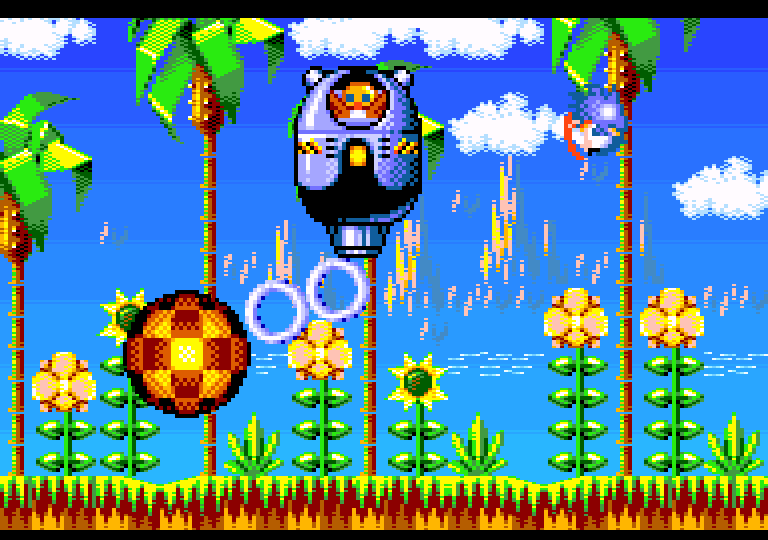
Amstrad fans were looking forward to seeing the blue hedgehog since the first forage appeared in 2019. Inspired by the Master System game, there are four Zones containing two Acts each – Green Hill, Bridge, Jungle, and Sky City (featuring conveyor belts and moving platforms, much like Scrap Brain Zone). There are also hidden Chaos Emeralds to find. There are also four impressive “3D” Special Stages, where Sonic runs into the screen, collecting a set number of Rings and jumping over spikey mines.
This is impressive, showing what the hardware can do. Graphics are excellent and scroll smoothly, and the soundtrack evokes the classic tunes. However, Sonic himself is quite a large, blocky sprite and lacks inertia; his size can make certain jumps trickier, especially when dealing with Robotnik’s machines. There are no power-up TVs to smash or loops to run around. It lacks depth with only eight levels, but searching for Chaos Emeralds does add to the gameplay. Amstrad fans really should check this out.
[Score] 87%
Black Screen
Format: Dreamcast, Steam
Credits: captkuso
Price: $9.99 (itch) / £8.50 (Steam)
This distinctive black & white space trading game sees you exploring a solar system. The streamlined navigation and simple controls make this a breeze to get into, with the quest taking about five hours. An enjoyable nostalgia trip that evokes memories of Elite and Empire.
[Score] 84%
Quarx
Format: VIC-20 (+35K memory expansion), C64, PET
Credits: David Murray (programming), Noelle Aman (music), Piotr Radecki (graphics), Troy Ablan (conversion tools)
Price: Free download / physical cartridge and disk versions available
Web: www.the8bitguy.com
The 8-Bit Guy’s take on Columns gives you a choice of four graphic sets (faces, blocks, symbols, fruit – represented with abstract designs on the PET) and three difficulties (four, five, or six colours). The VIC and C64 music are good, the VIC graphics are nicely designed, and it plays well. It lacks advanced gameplay features, such as wildcards or blocking pieces, but is still good fun.
[Score] 83%
PROCESSING - MUSKETEER (C64)
Jason Mackenzie of Psytronik:
Who is involved in making Sherwood?
The game was coded by Ola Zandelin with graphics and hand-painted artwork by Dennis Gustafsson. The game also features loading music by David Whittaker courtesy of C64Audio.
What makes it different to Musketeer?
There's more emphasis on exploration and item collecting in Sherwood. You need to collect coins in order to access the secret ending. The bow and arrows add a different gameplay mechanic as you need to fire arrows to dispatch enemies and also to hit flames that open up new parts of the screens, along with other secrets!
How many screens/rooms are there to explore?
There are 30 screens to explore.
What will be in the physical Collector’s Edition?
The boxed collector's edition will contain the game (tape/disk/cartridge), manual, stickers, a badge, a keyring, an A4 glossy art card, along with a soundtrack CD (which will also include the soundtracks from Musketeer as a bonus).
Physical editions are available via:
Digital edition available via:

Retro Gamer issue 282 was published on 12th February 2026
This blog was published on 24th June 2026
Not affiliated with Future Publishing
All interview content published with permission


Comments