

Homebrew Extra Retro Gamer 283
A last-minute change of plans sees a different game in our main feature, the brilliant Donut Dodo, which is now heading to retro formats. We have reviews of two games heading to Kickstarter and another that is only available on a physical Mega Drive cartridge, due to its special sound chip. We look forward to another Mega Drive project and follow the progress of our Champion Coder’s Atari 7800 projects.

QUICK LINKS
A LIVE DODO
Interview with Sebastian Kostka:
What inspired the original Donut Dodo?
I wanted to create my own take on the classic single-screen platformer, the kind of game you could imagine standing alongside arcade cabinets like Pac-Man or Popeye in the early 80s. That idea of a short, fast, and replayable arcade game was the starting point for Donut Dodo.
The game is very much a love letter to the early classics, particularly those from Namco and Nintendo. It’s still my favourite era of gaming, and one I keep coming back to both as a player and a developer, and that influence is probably never going to go away.
Were you surprised by how well it was received?
Yes, genuinely. I didn’t go into the release with any real expectations, and due to various circumstances, I wasn’t even able to properly market the game beforehand. That made the positive reception especially rewarding. Seeing players discover it organically and the community grow over time was both surprising and encouraging.
What made you try to convert it to retro consoles?
Donut Dodo was always inspired by early arcade titles, so seeing it run on the kind of hardware I grew up with just felt like the natural next step.
From a programming perspective, I’ve also been wanting to explore this for a long time. Working within the limits of older systems is a fascinating technical challenge. It forces you to be more intentional with every decision and really focus on what matters in the design.
Beyond that, retro consoles feel like the legitimate home for games like this. They open the door to proper physical releases including artwork and feelies, something that’s largely been lost over time.
How was the N64 version created, and what development tools did you use?
Donut Dodo was rebuilt from the ground up using a custom C-based engine I’ve been developing specifically to target both modern systems and actual retro hardware. The idea from the start was that the game shouldn’t know whether it’s running on a current PC or on a console from the 90s, aside from a few system-specific details like video, audio, and input handling. Because of that approach, the original Godot version couldn’t simply be ported. I had to shelve it entirely and reimplement the game from scratch in plain C, which was a big undertaking but ultimately made the N64 version possible. At the same time, that work has also laid the technical foundation for the sequel, Donut Dodo Fantastico.
For N64-specific functionality, I used the open-source libdragon development library, which provides low-level access to the hardware and integrates nicely with my engine.
How will the N64 version be available?
I’d like to offer both a digital download and a special physical release. An authentic cartridge feels like the right way to present a game like this, but N64 carts are expensive to produce, so it’s something that I’m approaching carefully.
The current plan is to gauge demand first, likely through a Kickstarter campaign, to make sure a physical run is viable and done properly.
FOOTNOTE: After this article was published, the Kickstarter campaign was a success, and is due to deliver physical cartridges in November 2026.
Are there any other formats you are planning?
A Dreamcast port is currently in the works, and the plan is to release it alongside the N64 version. I started with the N64 as it has tighter hardware constraints, and I wanted to see if the game and engine could be made to work comfortably within those limits. Having cleared that hurdle, I’m now confident that bringing Donut Dodo to the Dreamcast is very achievable.
Beyond that, I’d love to explore something like the Mega Drive one day, but those are very different challenges, so it’s one system at a time.
Would you like to see your other retro-inspired games make their way to older machines?
Absolutely, especially the arcade-style ones. I’m curious to see how these first retro releases are received, and if there’s an appetite for more, I’d be happy to explore bringing other titles to older machines.
I like the idea of treating the PC versions as the ‘arcade originals,’ with retro consoles getting their own ‘home conversions,’ as it’s a fun throwback to the 80s and 90s and something I’d love to push further.

ARCADE ASPIRATIONS
Five Steam hits from the Indie Arcade Heroes Bundle that nail the 80s arcade aesthetic.
Murtop
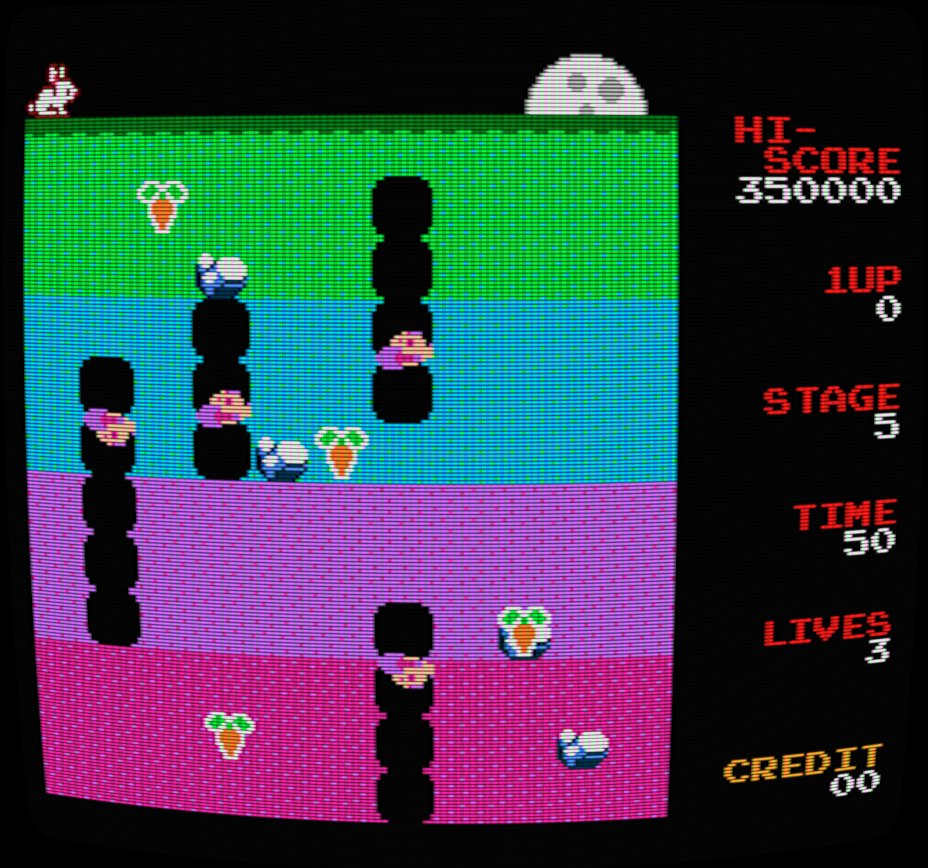
Mixing Dig Dug with Bomberman, Murti the rabbit defeats enemies by pooping bombs. Original creator Huilit is converting it to NES.
Cash Cow
In Donut Dodo’s follow-up, our bovine hero grabs the crystals and diamonds to rack up combos while dodging enemies.
Hoppy Hop
Another rabbit stars in this Q*Bert-inspired title, changing the floor tiles by hopping on them and dodging the shotgun-wielding fox.
Galacticon
Mixing Joust and Defender, rescue the prisoners and place them in the pods before heading to the next planet.
Annalynn
Grab rubies to make the snakes vulnerable and clear all the coins to complete each themed level in this cute platformer.
NEWS BYTES
Amiga: Dave18’s excellent Renegade conversion is released for AGA, with an ECS beta available. bit.ly/renegade-aga
Amstrad CPC: Typhonsoft’s Reginald and the She Vampires is a remake of 1987’s Mr Weems and the She Vampires. bit.ly/reginald-cpc
Atari STE: Puckman is a great conversion of the Namco classic, requiring 1Mb of memory. bit.ly/puckman-ste
Atari 8-bit: The New Year Disk 2026 includes Wrathchild’s brilliant conversion of 3D Monster Maze. bit.ly/ny2026-atari
C64: Bubble Bobble Lost Cave recreates the arcade mod’s 100 new levels, based on Davide Bottino’s recent Bubble Bobble Remastered. bit.ly/lostcave-c64
Game Boy Color: Yap and the Enchanted Bubbles is based on Pang. €9.99 for digital download, while Homebrew Factory will produce the cartridge. The first 100 preorders get a collector’s pin badge. bit.ly/yap-gbc
Mega Drive: Bailey the Brave sees you taking control of a sheepdog herding sheep and protecting them from UFO abduction. Free download at www.digitalmints.com/
Next: Mike Dailly has created an enhanced version of Mercenary for the Next. bit.ly/mercenary-next
Plus/4: Check out the superb Ghosts ‘n Goblins Arcade. bit.ly/gng-plus4
Saturn: Vigilant Paradise from Playnautic ($10 download) is a clever first-person shooter with two playable characters. bit.ly/vigilant-saturn
ZX Spectrum: Go-Go Bunnygun is a brilliant horizontally scrolling shooter from Ionian Games. bit.ly/gogobunny
Various: Inufuto’s latest, Awass, lets you move ladders to reach the flags. bit.ly/awass-inufuto

CHAMPION CODER - Laurent (ECDHE)
From: Massachusetts, United States
Website: https://ecdhe.itch.io/
Format: Atari 7800
Working on: Shotgun, Rogue7800, Galactic Dragon Invaders
A recent convert to the 7800, Laurent has three games in development right now.
When did you first play an Atari 7800?
About a couple of years ago. I vaguely heard about it back in the day, but had already moved on to computers. It's only when I started to delve into retro systems that I discovered the 7800 and what it can do.
What got you interested in programming the 7800?
It's a very powerful system. It has a very peculiar way of handling graphics (but then again, all Atari consoles do, from the 2600 to the Jaguar), but once you understand how it works, you can achieve impressive things that the NES or the SMS could only dream of! I also love the AtariAge community. As soon as I published the first version of Shotgun, I got some very useful feedback about the gameplay. One of them being to support the QuadTari to let four human players duke it out.
What is your development environment?
I develop in C using the cc7800 development kit, use Gimp for the graphics and a7800 for the emulator/debugger. I've written some games in assembly before, but aside from being tedious, it's sometimes hard to understand your own code a month later. This is why I like the C programming language. It's higher level than assembly, so makes programming easier, yet at the same time low level enough so I can have a pretty good idea of what it is compiled into. This provides me with the option to either insert some assembly or modify the C code for the parts of the game that need to run faster.
How did you decide to convert the game Shotgun?
I stumbled upon that homebrew, and I loved the gameplay, so decided to port it. The first version I wrote was actually for the GameTank, a homebrew console released in 2024. And then I decided to port it to 7800 as an exercise to learn to program on that console. I didn't expect it would have the reception it got - and certainly did not expect it to be nominated for an Atari Homebrew Award!
What have been the toughest parts of converting Shotgun?
Getting a decent AI without slowing down the game, as it needs to control up to three CPU players. This is where I've modified my C code so that the generated assembly would be more efficient - even if this led to writing some ugly C code.
Was it difficult to support the QuadTari hardware for four players?
It was easier than I expected, which is a good thing because I don't have any QuadTari! Thankfully, a couple of people on AtariAge were kind enough to test things for me on the actual hardware, and with a minimum of back and forth, I was able to get it working. Zero Page Homebrew had a Twitch session dedicated to multiplayer homebrew games and, with three of his teammates, got to play Shotgun using the QuadTari. That was really cool! And provided me with further feedback to improve the gameplay.
What is left to do on Shotgun?
It's considered complete. I would have liked to add a musical score but was not able to get something I liked, so I decided to declare it complete so that I can focus on Rogue 7800.
What made you decide to create a version of Rogue?
Because I grew up with computers more than video game consoles, my background is more computer games than console games. So I wanted to bring a different type of game to the 7800 than an arcade port. I first wondered about doing an RPG, but there are many challenges, including the need to save the player's progress (which is doable but is not an out-of-the-box feature on the 7800). This is where someone suggested I write a roguelike, which is much simpler. The challenge here was to come up with random mazes with the console's limited amount of RAM.
Are you adding anything to the basic gameplay?
I want to add a couple more items to add more choices to the player. Rogue is first and foremost about strategising, e.g. will you use your limited stock of arrows to safely knock out a monster from a distance, or will you use your sword but take damage? I also want to change how magical items are found. There is a Dungeons & Dragons rule for Dungeon Masters about special items, such as a magical sword: they should never be a free loot. Monsters shouldn't just guard it; they should use it against you. If players want that magical sword, they will first have to taste its effectiveness the hard way!
How difficult was it to get the maze scrolling?
It's not as much the maze scrolling as making sure the dashboard doesn't move. If the maze moves one pixel up, then I need to shift the dashboard one pixel down; otherwise, it will move up too. Which brings its bag of complexities. In order to achieve that, I decided to rip off the sprite layer that the cc7800 devkit provides and program directly the 7800 graphic chip interface known as the DLL (Display List List). This was a bit scary at first, but I really like the result. And it allowed me to easily add effects such as shaking the screen when you take a hit.
What have you got left to do?
Aside from more items, add sound and a musical score.
When do you hope to release the games?
Shotgun is complete. For Rogue, I would like to complete it sometime in 2026.
Will there be physical versions available in time?
I would love to get either game published as physical copies! Regarding Shotgun, this might be difficult due to the fact that I don't own the original IP. Regarding Rogue, I need to complete the game first! Then I will look for a publisher.
Are you working on anything else?
I am part of a group specialising on running game jams for obscure computers - the ones that got fewer than 100 games during their official lifetime. So I may come up with some quick games every now and then on computers you've probably never heard of.
But outside of those game jams, the only game I'm working on is Rogue. It's very tempting to start something new, but you end up with many unfinished projects. For instance, I have a murder/mystery game I started for the Atari 800XL a couple of years ago, and it's still on hiatus.
That doesn't prevent me, however, from thinking about other types of games. I still haven't given up on writing a satirical, Ultima-style RPG which makes fun of all the RPG clichés (not sure on what platform yet, though). For the 7800, I would like to make a game using large sprites and maybe parallax scrolling. One of the tragedies of the 7800 is that most of its games are ports from other platforms, so don't take full advantage of its capabilities. But I need to come up with an idea for a good game first.

DATABURST - REVIEWS
Death & Lead
Format: Mega Drive/Genesis
Credits: Kai Magazine Software
Price: physical edition €64.90 plus shipping
NOTE: Since this review was published, controversy has emerged about redrawn assets used in this game. There will be no comment or alteration of the review as it stands.
Superb graphics in the intro are accompanied by speech and outstanding music reminiscent of a spaghetti Western (thanks to the cartridge’s enhanced sound chip). Music, speech, and graphics throughout are excellent. Three difficulty levels and up to four continues are available; you will need them, as this is one tough game. It would have been nice to have more scenery to destroy, but this is a very polished and playable release.
[Score] 90% - Retro Gamer Sizzler
Tower & Dragon
Format: PET (40 columns, 8K memory, tape or disk)
Credits: Jason Cook (design, coding), Stephen Baker (title music)
Price: Kickstarter for physical version / free online version to follow
Designed to run on any PET, this RPG sees Frederick the knight attempt to save the kingdom, controlled by either the keyboard or an SNES joypad with an adapter. With a completion time of eight hours, this is hugely impressive, thanks to its clever PETSCII graphics.
[Score] 85%
Aethos
Format: NES
Credits: RetroBroGaming Entertainment (Jon Allogio coding & design), R-SEN Productions (music)
Price: free demo / Kickstarter
Web: bit.ly/aethos-demo (demo) bit.ly/aethos-ks (Kickstarter)
Winner of Best Music in the Byte Off V competition, AI explorer Kyra sets out to investigate if planet Aethos will be suitable for human life – but energy surges shut down her ship Elysium. This distinctive Metroidvania requires Kyra to explore four sectors of the planet, upgrade her abilities (including a shield and freeze shot), beat bosses, and finally defeat Zyrak, whose Nyzari race wants to dominate the planet. Good graphics and cutscenes, excellent music, and plenty of depth make this an excellent NES title heading to Kickstarter.
[Score] 88%

PROCESSING - VECTOR F (MEGA DRIVE)
Interview with designer Rahzelk:
Note from Rahzelk:
As you’ll see, Vector F is no longer moving toward a pure side-scroller direction. With the renewed team, we’re aiming for richer gameplay, which required a major rethink. The assets are still very early work-in-progress, so we’ll need more time before sending a ROM that truly reflects our vision.
Where did the original idea come from?
In one word: Sonic!
I’ve always loved Green Hill Zone for that insane burst of speed — that moment when the blue blur outruns the camera. But once you reach the infamous Marble Zone, things slow down dramatically. You just can’t blaze through the whole game at full throttle… at least not without serious skill.
So I wanted to create a game where that rush never stops — the kind of pure, exhilarating speed you find in those special chase sequences in games like Aero Blasters, Battletoads, or Alien Storm.
From day one, I also wanted the game to be multiplayer-focused. Something perfect for quick sessions and tournament play, whether at home or at retro-gaming events. A game that brings the Mega Drive back to the centre of friendly living-room rivalries, as a fresh alternative to the usual versus fighters.
And when you mix speed with competition, you naturally end up thinking “race.” But not a traditional race. The split-screen mode in Sonic 2 convinced me that players shouldn’t be visually separated. Instead of finishing first, the real goal should be surviving at high speed. That “death race” idea quickly became the heart of the game, blended with influences from movies like Running Man and Rollerblade.
The third core pillar for us was to create gameplay that feels genuinely original — not another shmup, not another platformer, and not just a Micro Machines-style racer either.
And that’s how the idea behind Vector F was born — a fresh, high-speed twist on competitive gameplay, crafted for instant pick-up-and-play fun!
Who is involved in the project?
The short answer: a bunch of “Gones.”
That’s local slang for kids from the city of Lyon.
Making a homebrew game is above all a human adventure, and we wanted an actual team that meets up, shares drinks, debates passionately, and builds something we can be proud of together.
The team has evolved over time, and we’re now seven “Gones.” Cyberdeous (two members) has been involved even before the first line of code and provide an incredible soundtrack to the game. More recently, we’ve had the chance to bring in two talented artists — Mehdi (character design) and Cyclopode (ships and assets) — along with two highly skilled players (Guillaume and Fuku San) who provide invaluable help on game design and QA. As for me, I mainly handle the development and lead the whole project, putting everything together.
Gones making homebrew? Let’s call it Gonesbrew!
How long have you been working on the game?
Development began in September 2024, with a dozen sprints of 3–4 weeks.
In May 2024, during the “Warp Zone”, a retro convention organised by a French enthusiast, RetroPolo, we hit both a milestone and the start of a long pause due to our previous pixel artist leaving the project. It took six months before we could resume development in late September 2025, this time with fresh and highly motivated reinforcements!
What is left to be done?
A new team means new perspectives - literally - and that includes revisiting what’s already been built. We’re currently redesigning all the assets and even refining parts of the gameplay. In many ways, it feels like starting over, with a lot of work ahead.
Fortunately, we can rely on the engine already in place and on the core gameplay principles that proved fun and solid.
Vector F will focus on fun and depth, just like arcade games of the era, rather than on sheer quantity of vehicles or tracks.
That’s why we’re confident: 2026 should be the year when the project reaches full speed and brings to life what is, for all of us, a childhood dream.
Will there be a physical cartridge as well as a digital download?
For every member of the team, the dream is absolutely to hold a physical Mega Drive cartridge of our own game. There will be copies for those who want them — the exact number will depend on demand. The digital version will be free and accessible to everyone.
The project has no commercial ambition, but depending on community interest, we might consider a crowdfunding campaign to produce more cartridges and add extra content (more ships, more levels, new game modes…).
Do you have any other projects in development?
Right now, we’re fully dedicated to Vector F. Our goal is to use this project to build a solid, long-term homebrew team — one capable of creating many more games for the retro-gaming community in the future.
A very special thanks goes to Stéphane Dallongeville (SGDK), without whom none of this would even be possible on the console that shaped my childhood.

Retro Gamer issue 283 was published on the 12th of March 2026.
This blog was published on the 15th of July 2026.
This is a personal blog and is not affiliated with Future Publishing.
Interview content is published with permission.


Comments