

Homebrew Extra Retro Gamer 286
We are covering a wide range of machines this time. Our main feature looks at Richard Langford’s PC remakes of classic Spectrum games, and our Champion Coder has just released his first physical games for the Neo-Geo Pocket Color. The reviews cover the BBC, NES, and a cracking new Game Boy platformer, the news features several great conversions, and we look forward to a forthcoming RPG for the venerable Apple. Enjoy the variety on offer!

QUICK LINKS:
NEW NOSTALGIA
Interview with Richard Langford:
How did you get started making Spectrum remakes on PC?
Richard: My first love was cartoon drawing. Back in the days of the Amiga, it became possible for me to transfer this hobby onto the computer. I drew a number of well-known characters and scenes, and, rather than just have a gallery of pictures, I made each one the background of a simple “Hunchback” style game, which I programmed in AMOS. This led me to remake two Spectrum games on the Amiga – The Pyramid and Cookie. Once the Amiga had passed its best days, I looked for something along the lines of AMOS, which I could make games with on PC. Enter GameMaker. I was a big fan of the Retrospec website, where some very talented people had done some amazing remakes of Spectrum games, and Gamemaker gave me the opportunity to give it a try myself.
What do you use to develop your games?
I use GameMaker GML code to put the games together. I think having used Amos, I had a bit of a head start with Gamemaker, and there are countless tutorial videos which helped. I’ve used Gamemaker for many years now but have still barely scratched the surface of what it can do – I learn a few new commands with every game! To make the graphics, it depends what look I’m going for. For Pixel art (which I admit I’m not so great at), I tend to use GameMaker’s built-in sprite editor. For hi-res graphics, I use a vector package called Serif DrawPlus – it’s very old now and has been superseded by Affinity, but I still use the old software as it can do basic animation, which the new version does not. I still tend to draw the game characters and the title screen art with pen and paper, scan them in and then manually “trace” the pictures vectors.
How do you choose which games to remake?
It all depends on what mood I am in. Sometimes I want to take a very simple game that isn’t going to be too difficult to recreate and then throw the kitchen sink at it, adding all sorts of options, animations, maybe extra screens, etc. Sometimes I’ll find a game that may have a mechanic or feature that’s going to be a challenge, or something I’ve not done before. The random maze generator for Fred is a good example of this, and the whole game of Rex was a challenge!
Have you had contact with any of the original creators?
If there is a way I can see to contact the original creators, I do like to try… I did contact Jas Austen, who wrote the original Rex for the Spectrum. It was good to hear from him some of the tricks he used to make the Spectrum game, and in some cases, quite surprising that we actually used the same overall methods to get certain things to work.
How did you start making covers for homebrew games?
As I said, cartoon drawing was originally my ‘thing.’ I chat a lot to Lee Chops Stevenson, who makes the fantastic Mr Hair games. I loved the Mr Hair character and, when it came to releasing one of the games physically, Lee asked if I would draw the cover, which I was more than happy to do. I ended up making covers for all the Mr Hair games (even though two had already been released with different artwork) and put them all together for a Mr Hair compilation. This led on to a few covers for Rich Hollins and, of course, those “Games for Windows” covers of my own games, which, though not released in physical format, I now use as covers both on my website and for PDF game manuals.
Several of your games offer a choice between a modern palette and an authentic Spectrum look. Do you think this is important, and how difficult is it to achieve?
I like to put in as many options as I can. If I am going down the path of taking the original Spectrum sprites and colouring them, then an in-game switch is a pretty easy thing to do. With Chuckie Egg, I offered the option of brand-new hi-res graphics or the Spectrum originals, though this was decided on the main menu rather than switching on the fly.
What have been the trickiest game mechanics to replicate?
That random maze generator for Fred was extremely challenging, and the reason I no longer have any hair! I would love to know how they managed it on the Spectrum version. Also, I struggled with getting the game difficulty right, as, because you only see a tiny fraction of the maze at once, it was impossible to see how many enemies the original had for each level.
Not quite so difficult, but still a challenge for myself, was getting the player movement exactly right for Manic Miner. It’s such a popular game that people have played to death that it had to be spot on. And getting it spot on meant going against all my own rules for making a platform game!
What inspires you to write something original instead of a remake?
It could be anything, really. The idea for Monkey Plant came from Andy Green, who also drew the Spectrum ‘mock-up’ for the finished game. Hairy Christmas actually began life as a remake of the Amiga game “Naughty Ones” (one of my favourite platform games). It grew into much more than a remake, though, and I decided to turn it into Mr Hair’s first HD outing (Mr Hair was already the star of many Spectrum homebrew games by Lee Stevenson). In the case of Bat ‘n’ Ball, it was just a genre of game I’d not tried before, and I wanted to give it a go.
How complex was it making and remaking The Utterly Splendid Adventures of Horace, containing all the old tiles, and working with the license?
Horace was such a fun game to make. I started it many years ago, and for some reason, life got in the way, and it fell by the wayside. By the time I looked at it again, the first version of GameMaker was no more, and I started again from scratch using GameMaker 2. I didn’t go anywhere with it until I had permission to use the character, which the IP holder was more than happy with – then there was no stopping me! The original Horace games were very loosely based on arcade games – Hungry Horace was Pac-Man, Skiing had elements of Frogger, Spiders was reminiscent of Space Panic, so I just went for it to see how many games I could get Horace into. I had Q*Bert, Pengo, Burger Time, Tapper, Hunchback, Space Invaders and even a suggestion of Jetpac and Lunar Jetman. Each level and sub-level was completely different from the last, so this game took me well over a year to finish completely.
What do you currently have in development?
I have an original and a remake on the go at the moment. The original game is a spin-off of the Project ZX games – not just a straight-forward scrolling shooter as the others in the series have been. I have stalled on that at the moment, though, and I can’t be sure it’ll get finished! While I think that one over, I also have a remake of a stone-cold Spectrum classic going on – just something that wouldn’t be too brain-taxing while I get my head around the Project ZX game.
What would be your dream Spectrum game to remake?
I keep going back to and looking into Don Priestley’s brilliant Trap Door. Every time I do it gets to a point where I’m stumped, and I’m thinking “How on Earth can I do that”? There’s so much that goes on in that game that I’m left wondering how I could pull it all together. One day, the answer will just hit me, and I will get on it – I’m so looking forward to re-creating Berk and his pals!
Is there anyone you would like to work with?
Steve Watson is another very prolific creator of Spectrum remakes – he’s responsible for the remakes of Scuba Dive, Olli and Lissa, Batty and the Exolon ‘sequel.’ We chat a lot online, and it would be good to pool our resources and work on an original game together.
Would you tackle games from other formats, or will you stick to Spectrum?
I have dabbled with Atari 2600 remakes before. I challenged myself to see if I could completely recreate the 2600 version of Space Invaders in one day. As far as getting the basic game up and running, I did manage it but then decided to take more time putting in all the original 2600 game variants and some new graphic overlays. I also remade H.E.R.O which was my favourite 2600 game. I never really played the Spectrum version back in the day, but I guess my version was more modelled on that. Also, as mentioned before, my Mr Hair game, “Hairy Christmas,” actually started life as a remake of the Amiga game “Naughty Ones.”
What would be your favourite five remakes/original games that you have made as Langford Productions?
Project ZX – Can all three of these games count as one choice? These games were a lot of fun to put together and went down really well with Spectrum fans. Having made the first two games in the first version of GameMaker, I wanted to make a third one using GameMaker 2, especially as I’d learned so much since the previous games. So project ZX 1.5 came about using the best bits from 1 and 2.
Highway Encounter – One of my earlier remakes and one of my top three Spectrum games. I was really pleased to get the isometric 3D working. Highway Encounter was quite simple, as there’s no jumping, so no “height” is involved, but I’d like to have a crack at another isometric game.
Mr Hair and The Fly Redux – I loved Lee’s original, and it was screaming out for an expanded PC remake. With help and suggestions from Lee, I added so much to this version – I think the map is around 4 or 5 times bigger; there are cut scenes, boss fights, new game mechanics, and Pedro (Pimenta) even revamped the original music for me!
Monkey Plant – An original game with a very retro feel from an idea by Andy Green (who has produced some amazing Spectrum loading screens). It’s a simple game but fiendishly difficult. I gave the robots a very simple design and had a lot of fun doing all the animation for them.
Bat ‘n’ Ball – Half remake, half original. Started life as a remake of Arkanoid, but I kept getting more and more ideas of stuff I could add to expand it. So it ended up with different shaped levels, sideways screens, screens with bats at the top and the bottom, disruptors (as used in the Spectrum game ‘Batty’ to change the ball direction, invisible blocks, exploding blocks, falling blocks… the list goes on. I was really pleased with the look and feel of the game and the music that fits it so well.
See more at https://langfordproductions.com

NEWS BYTES
Amstrad CPC Plus: CP Soft is working on a brilliant conversion of Q*Bert, so try the latest update at bit.ly/qbert-cpcplus
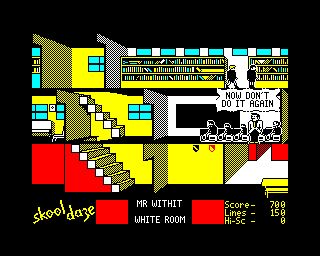
BBC Micro: Rob Coleman has converted the Spectrum classic Skool Daze for Master and Compact users. bit.ly/skooldaze-bbc
Game Boy: Take on the first case of Phoenix Wright: Ace Attorney in 2-Bit Crook’s excellent demake. bit.ly/aceattorney-gb
Jaguar: BurgerTom is OCEO’s brilliant conversion of the arcade game BurgerTime. bit.ly/burger-jaguar
Master System: LackofTrack entered their proof-of-concept Super Mario Bros. World 1-1 demo into the recent SMS Power competition. bit.ly/mario-sms
Mega Drive: The classic indie platformer Cave Story arrives thanks to andwhyisit, with support for multiple languages and 6-button controllers. bit.ly/cavestory-md
MSX: Mastropiero is back again, this time with Super Pac-Man for any MSX model. bit.ly/superpac-msx
NES: ‘It’s not the destination, it’s the journey’ was the theme of the recent Byte Off VI contest for NESmaker games. NESmaker is rebranding soon as the new look Retro Game Forge… bit.ly/byteoffvi
SNES: The SNES Dev Game Jam 2026 runs from the 31st of July to the 31st of October, with a 512 K limit. bit.ly/snes2026
ZX Spectrum: Kevin Toms and Glen Anderson released the updated Football Manager International – 2026 World Cup Edition with all 48 teams through Midnight Brew Games, free to download for 48K and 128K machines at bit.ly/fm2026-zx
CHAMPION CODER - CHRIS AHCHAY
From: Godalming, Surrey
Format: Neo-Geo Pocket Color
Previous games: Don’t Die Mr Robot, Fruity Pals’ Revenge
Working on: Horatio Goes Snowboarding, Rogue Aces Jr.
Chris is working with Infinite State Games to bring their titles to SNK’s handheld.
What got you into developing for the Neo-Geo Pocket?
Chris: I had the NGPC when it first came out in the UK – so around 1998/99 – and I absolutely loved it – I put countless hours into Sonic, Metal Slug and Cardfighter’s Clash on my commute. Of course, nowadays we all know that it was doomed to be a short-lived affair as SNK was in its death throes at the time.
When SNK finally went bust, and Aruze took over, the supply of new games started to dry up - I drew the line at the endless stream of Casino and Pachinko games that the Aruze-driven tail end produced. I spent a bit of time building up a collection of the UK-released games, and importing games from Japan – but when boxed copies of Evolution etc started changing hands at £100 (and after I’d spent a few weeks trying to decipher what the hell was going on with Ganbare Neo Poke Kun) I decided that it was time to hang the pocket up.
Daft, really, when you see the price that some of the harder-to-find NGPC games fetch now, but hindsight and all that.
Anyway, on one of my visits to Play Asia, I spotted a thing called a Bung Flash Linker, and I figured that this was a way for me to play the games that I couldn’t really justify dropping £100 or more on.
That led me to Yahoo Groups (is that retro enough for you?), where I discovered that there was a small group of people who had been trying to get homebrew running on the NGPC – and I think I turned up at just the right time as Dark Fader had just released a small demo of a Pac-Man game written in C rather than Assembler. That, pretty swiftly, turned into the first version of a C framework, and I was hooked – I contributed a bunch of stuff to that project, but all the hard work had been done by DF, Thor and Ivan Macintosh before I arrived.
Since then, over the last 25 years or so(!), I’ve sporadically gone back to the NGPC and have written a bunch of demos and small games – mainly conversions of arcade games like Mr Do, Robotron and Joust. Some of them have worked out better than others (Robotron was never really going to work with only a single joystick and two buttons) – I was quite pleased with Barbarian Invaders, which was based on the description of a Space Invaders-type machine in Terry Pratchett’s Colour of Magic book.
What is your development environment?
There’s no magic bullet, I’m afraid; it’s all very old-school – it’s all manually-coded C compiled with the Toshiba T900 compiler. I use VS Code as an editor with custom build scripts.
There is a framework that gives me common functions for interacting with the hardware - creating sprites, managing tiles and so forth- and I’ve developed that further over the years to suit my programming style.
For graphics, I use a custom Tile editor called NeoTile, which is incredibly basic but just works - there are various tools available for converting bitmaps and so on to NGP format, but I don’t really use those.
Sound has been a recent breakthrough – the Furnace Tracker added NGPC chip support a couple of years ago, and one of the NGPC dev forum regulars (Winteriscoming) reworked the NGPC sound driver to use that, and that has been transformative in terms of getting complete games working on the NGPC.
If any of your readers are interested in NGPC development, I have all the tools and a series of tutorials on my website at https://ahchay.com/NGPC/
There is a newer version of the framework, which has been built from scratch, and I believe the developer there is looking to create a GB Studio-style build engine, but I haven’t had a chance to investigate this thoroughly myself.
What made you convert Don’t Die, Mr Robot?
Pure love for the original games from ISG! I’ve known Mike and Charlie for years and have followed every release they’ve made – they have such great instincts for what makes a good videogame.
I’d thrown together a quick animation test for Mr Robot about five years ago and then quietly parked it.
In the meantime, I’d gotten myself bogged down in an (overly?) ambitious game called Defenderoids – a mash-up of Defender and Asteroids using a custom bitmap engine that I developed for the NGPC, with elements of Qix, Space Invaders, Sinistar and, for some reason, Lemmings. I was enjoying that project, but honestly was tying myself in knots with it, so I took the decision last September to shelve that and thought that maybe I should try and make a simpler one-screen game that was more suited to the strengths of the NGPC. I looked through my old project files and DDMR just jumped out – I knocked up a quick demo version (just Mr Robot and some basic enemies milling about and uploaded it to the ISG Discord, and it just ballooned from there.
Mike and Charlie have been fantastically supportive, and with Mike working on the music, the game came together incredibly quickly - It was less than a month between that initial demo and the first released version.
What inspired Fruity Pals’ Revenge?
The original idea was to create a quick “B Side” game for DDMR – I wanted to try a physical release, and the only flash carts available at the time were quite expensive, but do have the ability to switch between two games on the cart.
I’d had a version of Same Game (a game design that goes back to the mid-80s by Japanese developer Kuniaki "Morisuke" Moribe) that I had worked on previously, and Mike and I thought that if we put a bit of an ISG spin on it, it would fit the bill.
As it turned out, we both think it’s good enough to stand on its own – not necessarily better than DDMR, but at least as good as, and the two games complement each other perfectly.
How difficult was it to get physical copies created?
Not especially difficult, but there were a lot of false starts and dead ends.
Initially, I thought that physical copies would be hard to do in any great volume – the only flash carts on the market were quite expensive ones like Flashmasta and the Retro HQ Game Drives.
I considered doing a crowd-funded campaign for some “premium” releases with two games for around £80, which wouldn’t have made me very much money, but at least would have got the game out there. I flip-flopped on that for a couple of months while also working on some new ideas with ISG, but then stumbled across a firm producing a new USB linker and flash carts for the NGPC (Gamebank). This is only available in Japan, but I managed to snag a set from Amazon. I’ve since discovered that about 40% of the ripoff NGPC carts on AliExpress can also be reflashed with the same device, so between buying 90% of the available Gamebank flash carts and repurposing the hokey AliExpress carts, I managed to get about 23 physical copies made. This does mean that I now have a massive random collection of dodgy NPGC carts, which I now don’t know what to do with, but at least I can play the English translation of CFC2 now.
I’ve since got in touch with the supplier and can hopefully guarantee a regular supply of the Gamebank carts – albeit in batches of 20 or so
I’m using repurposed Everdrive boxes for the cases and am printing the manuals and slipcases at home using a colour laser printer. I get cart labels produced professionally, and may end up doing the same for manuals and covers if there is enough demand.
I’d also like to publicly thank Rob Fearon for doing some amazing artwork for us.
Will you continue to work on your arcade conversions – Joust, Robotron, Mr Do, and Juno First?
As you have spotted, my first love is early 80’s arcade games, so yes, I will always return to that for inspiration.
I do have a hankering to go back to Mr Do! and Joust – I could do those better now than I did 20 years ago – Robotron doesn’t really work on the pocket, but it was a fun thing to do – I originally did this as a “seven-day” project for Way of the Rodent’s “Eugenius” issue – it is the greatest game ever produced after all. I’d quite like to do a version of Pooyan – a criminally underrated game in my opinion, and would work beautifully on the NGPC.
I do have a WIP version of Bubble Bobble, which is coming along pretty well, although I’m not sure I can quite replicate some of the nuances of the original. That might see the light of day in some form, although I doubt if I’ll ever officially publish it.
Your website has other projects in progress. What is happening with them?
A lot of those are sketches and proof of concepts – but never say never – I have more ideas than time, so who knows?
Do you have anything else in development? Will there be more conversions of Infinite States titles?
I’m going to answer these questions together, I think…
The short answer is yes. I am working with Mike on demakes of the entire ISG back catalogue, basically – so far we have Horatio Goes Snowboarding, which will be released any day now, Rogue Aces Jr., which is mostly there but needs a bit more polishing before it’s ready for the limelight, and a sequel to Family Tree/Frutorious called Back to my Fruits.
I suppose I should add Mowguelike to the mix at some point as well…
I’ve also been working on an old-school wave shooter, Gardenia, which is a bit of a mix of Galaxian, Galaga and Phoenix set in a garden, and that is coming together very nicely!
And because writing NGPC games isn’t enough work, I’ve also decided to try producing a standalone emulator that we’re calling the ISGBoy to publish the games directly to Steam.
We’re aiming to have Horatio ready for release by the time this interview appears, and then we will follow on with Rogue Aces and Back to My Fruits by the end of the year. From there? Well, that remains to be seen – I’ve been doing this (off and on) for 25 years, so I don’t expect to stop any time soon.
Is there a dream project you would like to work on?
Honestly, this is it. This whole collaboration with ISG has been a dream, and I couldn’t have asked for anything better.
What other retro formats would you like to work on?
Obviously, the NGPC is a bit of a niche console, and I’d love to get these games onto something that has a wider appeal – I’ve been looking into both NES and Game Boy development tools to see whether I can translate the framework and migrate the core game logic without starting from scratch.
But my heart will always be with the little clicky sticks of the Neo Geo Pocket.

DATABURST REVIEWS
Mega Kaiju Boom Ball
Format: NES, Steam
Credits: Orebody Inc. (including John Vanderhoef and Jordan Davis)
Price: $9.99 (NES download) / $7.99 (Steam) / $70 plus postage (physical NES cart)
What happens when you cross Arkanoid with Godzilla-style monsters? This interesting mix of mechanics plays well but can be frustrating if you drop the ball. Extra modes, including the ‘boss rush’ Stadium, add to the longevity. An unusual and enjoyable title funded by Kickstarter and now on Steam.
[Score] 87%

Black Castle II
Format: Game Boy
Credits: User0x7f (design, programming, graphics), Retro Asobi (music)
Price: Free download / play online
Web: bit.ly/blackcastle2
The villain of the original Black Castle, Malakar the warlock, has returned, taking Lyra to sacrifice her in a ritual for more power. Lyra’s brother, Aric, picks up his sword and heads off to defeat the warlock again and save his sister. Drawing on classic Castlevania and Super Mario Bros titles, there are five large stages split into smaller sections, with hidden secrets and extra weapons to discover. Boss creatures are waiting at the end of each level before you face Malakar in the ultimate battle. Smooth and well-defined graphics give a great atmosphere, and the music throughout is excellent. This sequel refines and improves on the original, which is also worth playing.
[Score] 88%

Chuckulus
Format: Acorn Electron
Credits: Snuggsy187
Price: Free download / play online
Web: bit.ly/chuckulus
Previewed back in RG 273, this innovative title mixes the classic platformer Chuckie Egg with the rotating towers of Nebulus. The graphical effect is really impressive for the hardware; the graphics feel authentic to the original Chuckie Egg, and the sound fits perfectly. This is a really challenging game for the eggheads out there.
NB: Now available for BBC Micro as well. https://bbcmicro.co.uk/game.php?id=4575
[Score] 84%

PROCESSING - ANDORIA (APPLE II)
Emmanuel Castello is creating the new RPG Andoria, inspired by the classic Ultima IV.
When did you start developing for the Apple II?
I started developing for the Apple II at the age of 12, using Applesoft BASIC. I continued improving my Apple II skills, but I never learned Assembly language at the time for a combination of reasons: I didn’t have the necessary resources (software, books, or documentation), I didn’t have anyone who could guide me (a teacher or a friend), and I don’t think I had the intellectual maturity to learn it on my own.
What inspired Andoria?
I left the Apple II world in 1991 and moved on. In 2020, after watching some vintage computer videos on the internet, nostalgia struck me, and I felt like coming back. I watched a particular video in which David Murray, the 8-Bit Guy, presented a game of his own, and I wondered whether, at the age of 49, I would be able to write a game in Assembly language—something I had never done before. Of all the games in the Apple II catalogue, Ultima IV was the most mind-blowing to me—the first true open-world game. So I decided to create an “Ultima”-style game, with the idea of making some adjustments to address its sometimes-tedious gameplay.
What tools do you use to develop?
I wrote the game in Assembly, using an online compiler. I then used AppleWin, which helped me debug the code as it was running. I also used spreadsheets to create the data tables, copying and pasting them into the Apple II’s emulated RAM.
What are you hoping to add to the demo for the finished game?
The demo version is simply a preview of the gameplay, featuring a limited map, weapons, and vehicles. The finished game will include the full map (65,000 tiles), the complete storyline, dungeons, and the very important Vessel—a ship where you can store food, water, and gold, and dive beneath the sea with a diving suit in search of special items and treasures.
Will you be publishing a physical edition or just a digital download?
Yes, there will be a digital download option, as well as a physical edition with a box, floppy disks and manuals.
Are you working on any other projects?
No, a couple of years ago, I launched an arcade game based on the legendary PONG. It is available as freeware on the CALL Apple Magazine.

Retro Gamer issue 286 was published on 4th June 2026.
This blog was published on 29th October 2026.


Comments